Global nuclear power generation reached an all-time high in 2025. In the same year, solar generated more electricity than nuclear for the first time.
Those two milestones capture much of the tension in the World Nuclear Industry Status Report 2026 (WNISR2026). Nuclear remains a significant source of low-carbon electricity and reactor construction is at its highest level in decades. But new nuclear development is increasingly concentrated in China and Russia, while solar, wind and battery storage are expanding at a far greater pace.
According to WNISR2026, the world’s nuclear reactors generated 2,703 TWh in 2025, up 1.1% from the previous year and the highest annual output on record. The World Nuclear Association (WNA) puts 2025 nuclear generation at 2,702 TWh, up 35 TWh from 2024, and also describes it as a new record.
Growth is increasingly concentrated
WNISR attributes the entire increase in nuclear generation in 2025 to China. Outside China, nuclear output declined slightly and remained 14% below the level recorded two decades earlier.
According to the report, four reactors started operating in 2025 while seven closed. Over the 20 years from 2006 to 2025, 104 reactors started operating and 106 closed.
China accounted for 53 of those start-ups and none of the closures. Excluding China, the global operating fleet therefore declined by a net 55 reactors over the period, representing a loss of almost 30.7 GW of nuclear capacity. However, the construction pipeline looks rather different.
WNISR counted 73 reactors under construction in 14 countries as of 1 July 2026, the highest number since 1987. China accounted for 37. Chinese and Russian companies were implementing 63 of the 73 projects, either domestically or overseas.
More recent WNA data puts the number at about 80 reactors under construction in 15 countries. The difference reflects, among other things, different reporting dates as projects start construction and completed reactors enter service. Both datasets point in the same direction: new nuclear construction is heavily concentrated in Asia, with China and Russia dominating the market.
The International Energy Agency (IEA) adds another useful measure. It reports that 94% of the reactors that began construction during the past decade were of Chinese or Russian design. A substantial nuclear construction programme is clearly underway. What the numbers do not support quite as comfortably is the idea of a broad-based global nuclear construction boom.
Solar crosses the nuclear line
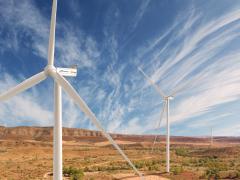
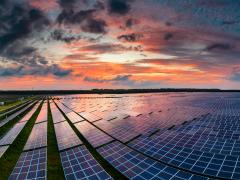
WNISR reports that solar generation grew by 30% and exceeded nuclear generation globally for the first time. Wind finished just 16 TWh short of nuclear output, while wind and solar combined generated more than twice as much electricity as nuclear.
IEA data tells much the same story from another direction. Solar PV generation increased by around 600 TWh during 2025, taking total output to nearly 2,700 TWh. The increase was the largest recorded for any electricity source in a single year outside periods of recovery from major economic shocks. Solar alone accounted for around 70% of the increase in global electricity generation.
Comparisons between nuclear and solar need some qualification. A terawatt-hour is a terawatt-hour on an annual energy balance, but the technologies do very different jobs within a power system.
Nuclear plants typically operate at high capacity factors and provide continuous generation. Solar varies by time of day and weather, so as its share grows, the system needs flexibility elsewhere. That can come from transmission, flexible demand, dispatchable generation, storage or some combination of them.
What is changing is the scale at which some of those supporting technologies are being deployed. The IEA says 108 GW of battery storage was added globally in 2025, 40% more than in 2024. Installed battery storage capacity is now eleven times higher than it was in 2021.
Solar and nuclear are therefore not becoming interchangeable. But storage is steadily changing the terms of a comparison that once ended with the observation that the sun does not always shine.
SMRs remain largely a future proposition
Small modular reactors have been presented for years as a possible answer to some of the cost, scale and construction challenges associated with conventional nuclear plants.
WNISR notes that, after more than a decade of development programmes and project announcements, only one SMR was under construction in the Western world at its reporting cut-off: Ontario Power Generation’s project at Darlington in Canada.
Much more activity is in the pipeline. Governments in the US and UK have committed substantial public funding to SMR programmes; projects are progressing in several other countries and Russia and China already have small reactor designs in operation.
Large reactors nevertheless still account for almost all nuclear capacity under construction.
SMRs may yet change the economics and delivery model of nuclear power. For now, the commercial evidence remains considerably smaller than the attention the technology receives.
South Africa has skin in the game
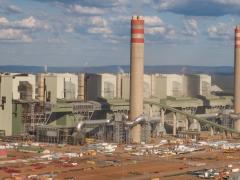
The global numbers have direct relevance for South Africa, which remains the only country on the African continent operating a commercial nuclear power station.
Koeberg’s two approximately 900 MW reactors have now received 20-year operating licence extensions. Unit 1 is licensed until July 2044 and Unit 2 until November 2045.
Output recovered strongly in 2025 after the lengthy outages associated with the station’s life-extension programme. WNISR records net generation of 10.2 TWh, compared with 7.8 TWh in 2024, when Unit 2 was online for only 33 hours. Koeberg supplied about 4.6% of South Africa’s total electricity generation in 2025.
South Africa is also planning considerably more nuclear capacity.
IRP 2025 provides for 5.2 GW of new nuclear capacity by 2039, comprising two 1,250 MW units followed by two 1,350 MW units. A further 4.8 GW is envisaged after 2040, potentially taking additional nuclear capacity to 10 GW over the coming decades.
The timetable is ambitious. Delivering it will depend on procurement, financing, regulatory approvals and construction schedules, all areas in which nuclear projects internationally have produced sharply different outcomes.
At the same time, South Africa has experienced rapid growth in decentralised solar generation.
WNISR identifies increased rooftop solar as one factor behind lower demand from Eskom during the country’s recovery from loadshedding, alongside improved performance from the utility’s coal fleet. Coal remained dominant in 2025, accounting for 79% of national electricity production.
South Africa is therefore already dealing with the question visible in the global numbers: how existing large-scale generation, new nuclear, rapidly expanding renewables and storage fit together in a power system undergoing substantial change.
The ageing fleet cannot be ignored
New construction is only one side of the nuclear equation.
WNISR records 224 power reactors permanently closed worldwide by mid-2026, representing 111 GW of capacity. Of these, 25 had been fully decommissioned and ten sites had been released for unrestricted use. For reactors that had completed the process, decommissioning took an average of 22 years.
That becomes increasingly relevant as the existing nuclear fleet ages. Lifetime extensions are allowing many reactors to operate well beyond their original design periods, preserving large volumes of low-carbon generation without the lead times and capital requirements of entirely new plants.
But extending an existing reactor, constructing a new one and decommissioning a retired plant are three different engineering and financial propositions. Comparisons of nuclear costs and future contribution need to account for all three.
Beyond the renaissance argument
WNISR2026 is openly sceptical of claims that the world is experiencing a nuclear renaissance. The WNA, unsurprisingly, sees considerably stronger prospects for growth. Its 2026 outlook argues that national targets, identified projects and continued operation of existing reactors could take global nuclear capacity to 1,457 GWe by 2050 if those ambitions are realised.
Nuclear produced more electricity than ever in 2025 and remains responsible for around 9% of global electricity. Construction activity is at one of its highest levels in decades. Several major economies are again backing new nuclear development.
But much of the actual construction is concentrated in China and Russia. Outside China, the operating fleet has contracted over the past two decades and SMRs have yet to move into widespread commercial deployment.
Meanwhile, solar added around 600 TWh of generation in a single year and passed nuclear’s annual output for the first time. Battery storage is scaling rapidly alongside it.
For South Africa, the useful question is less whether nuclear or renewables will “win” than what each technology can realistically deliver.
Koeberg will remain part of the electricity system for another two decades. Government intends to procure new nuclear capacity. Wind, solar and storage can be developed on much shorter timelines and are already being added to the system.
The decisions ahead should be based on delivery as much as ambition: what can be built, by when, at what cost and what the wider electricity system will require to use it effectively.