
As corporate renewable-energy procurement accelerates in South Africa, securing renewable electricity is becoming only one part of the equation. Variable wind and solar generation, changing electricity demand and fluctuating market prices can all affect the savings a business ultimately achieves.
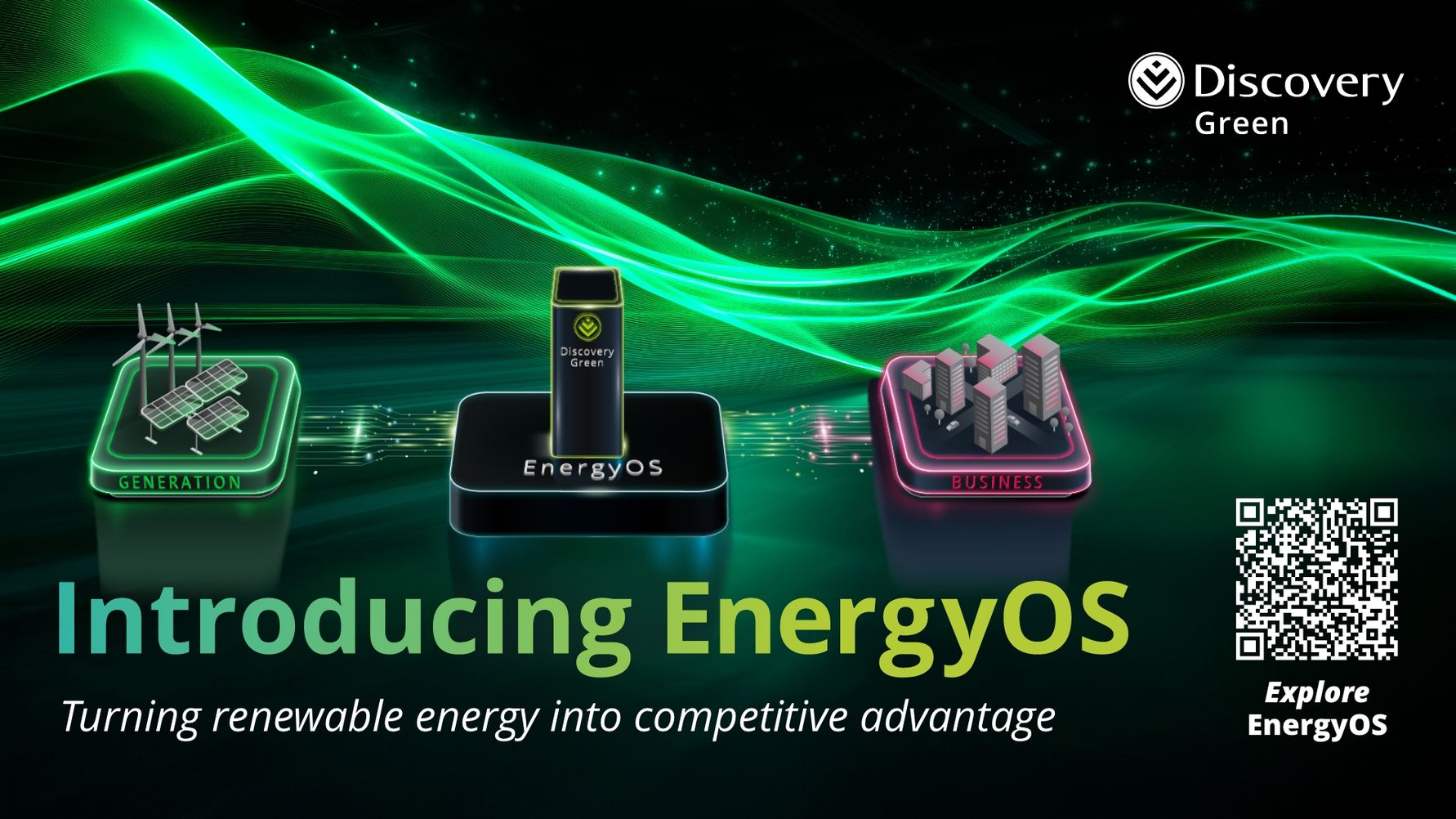
Enter Discovery Green's EnergyOS, a proprietary renewable-energy operating system designed to model and manage these variables across business energy portfolios.
According to research conducted by Discovery Green, annual savings from renewable-energy procurement can vary by as much as 35% in either direction for wind generation and 19% for solar. Under some scenarios, anticipated savings can become losses.
The company describes this as a renewable-energy trilemma: businesses want to maximise savings, reduce emissions and manage financial risk at the same time.
Traditional renewable-energy procurement has largely concentrated on securing an appropriate volume of electricity at an attractive starting price. Discovery Green argues that this approach does not fully account for what happens once variable generation interacts with a business's changing electricity consumption and market conditions.
EnergyOS was developed to manage that uncertainty by combining forecasts for renewable-energy generation, electricity consumption and future market prices. It then uses these alongside business-specific requirements and energy-allocation capabilities to determine how renewable energy can be allocated across a portfolio.
EnergyAI provides a continuous feedback loop, allowing the system to adjust and learn as conditions change.
Modelling a range of possible outcomes
Rather than relying on a single forecast, EnergyOS models many possible future scenarios.
Discovery Green says the system has been tested across more than 10,000 consumption simulations, 87 million generation simulations and more than 200,000 future market price points.
Based on these simulations, the company reports that EnergyOS achieved an average 88% reduction in risk and a 105% increase in savings relative to traditional procurement approaches, while reducing electricity emissions by 90%.
“Many businesses typically assess renewable energy procurement based on its price and quantity, treating it as a commodity in a stable world,” says Andre Nepgen, CEO of Discovery Green. “But this is a dangerously narrow view. The real measure of success is whether that energy delivers sustained savings, manageable risk and meaningful emission reductions across a wide range of potential futures.”
The approach draws on risk-management and modelling capabilities developed within the broader Discovery group.
“For more than three decades, Discovery has developed unique capabilities in risk management,” says Dan Ginsberg, Head of Actuarial and R&D at Discovery Green.
“The renewable-energy market presents many of the same fundamental challenges. Generation fluctuates, demand is unpredictable and future market conditions remain uncertain. EnergyOS brings actuarial thinking to these challenges so that renewable energy can be managed with greater sophistication.”
From energy procurement to risk management
The actuarial approach provides a useful way of understanding the system.
It is impossible to predict precisely how much wind or solar generation will be available at every point in the future. Nor can a business know exactly how its electricity requirements or future market prices will change.
EnergyOS instead considers millions of potential generation outcomes against thousands of energy-consumption patterns and a range of future market prices. This produces a statistical distribution of possible outcomes rather than relying on a single projection.
The forecasting capability feeds into Discovery Green's customisation model, which incorporates each business's requirements and risk appetite. Its allocation model then determines how to distribute energy across a portfolio of businesses to improve savings and reduce risk.
As new information becomes available, EnergyAI feeds it back into the operating system.
“No one can predict with complete certainty how the wind will blow, how the sun will shine, how a business's electricity needs will change or how the energy market will evolve,” Nepgen says.
“The answer is not to pretend that this uncertainty does not exist. It is to understand it, quantify it and manage it more effectively on behalf of businesses.”
A changing corporate energy market
The launch comes as South African businesses have access to a growing range of renewable-energy procurement options and significant investment continues in new wind and solar generation.
This growth also makes the commercial management of renewable energy increasingly important. The initial price of renewable electricity remains relevant, but the eventual business outcome depends on how generation, consumption and market exposure interact over time.
Discovery Green believes renewable-energy portfolios can therefore be pooled, modelled and managed using some of the principles applied to risk in financial services.
The company also links the approach to Discovery's shared-value model: if better risk management improves the financial case for renewable energy, businesses have greater incentive to increase their renewable-energy investment, with corresponding emissions reductions.
EnergyOS will underpin Discovery Green's offering to new business clients, while the company says it will migrate existing customers to the system during 2026.