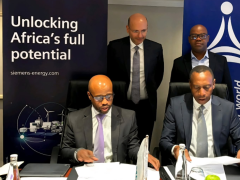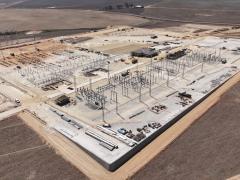
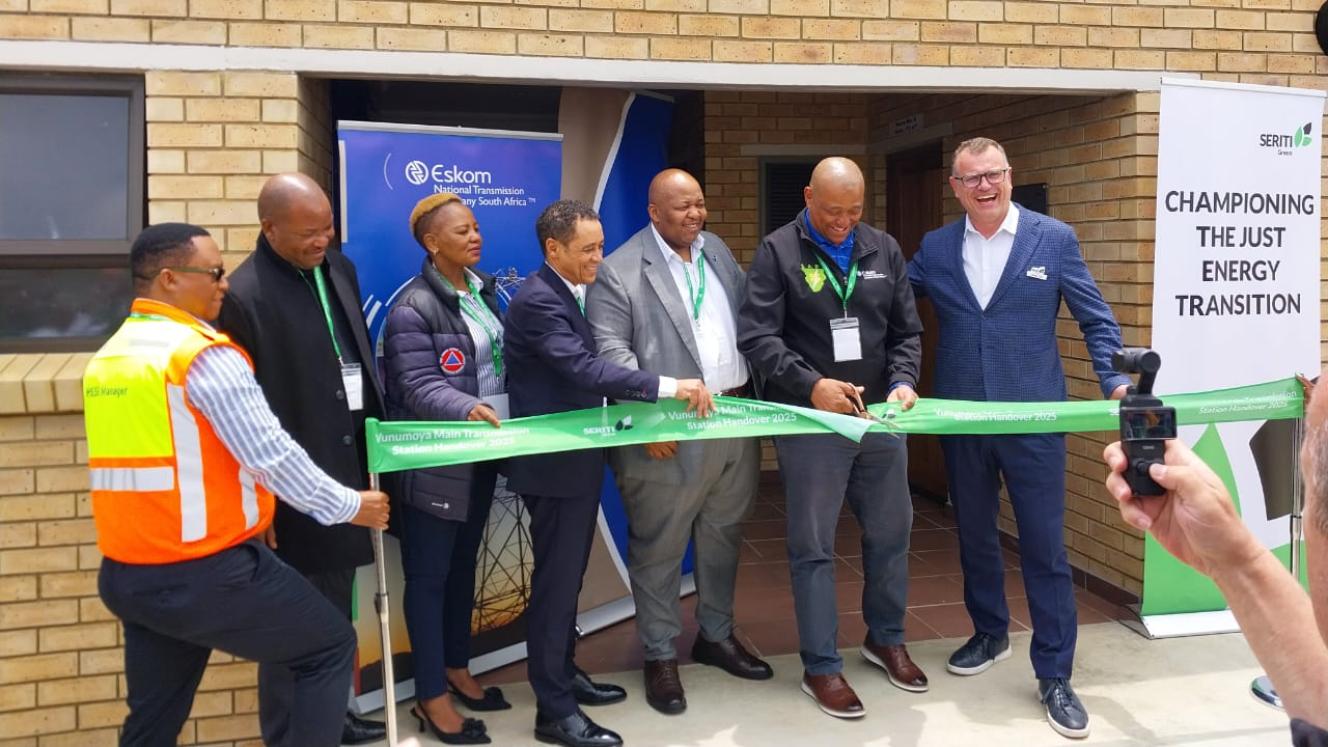
Seriti Green officially handed the Vunumoya main transmission station (MTS) to Eskom on November 26 at the site near Bethal, Mpumalanga, completing a privately built 400/132 kV substation designed as the primary grid injection point for the 900 MW Ummbila Emoyeni renewable energy programme.
Constructed over 17-18 months, the station includes a 500 MVA 400/132 kV transformer and is designed to accommodate a second 500 MVA unit with the first transformer installed and energised as part of the initial phase. The facility also comprises fully equipped 400 kV and 132 kV yard infrastructure and space for additional feeders to support future load growth.
Seriti Green CEO Peter Venn said the project demonstrates how private developers can accelerate transmission delivery in constrained areas.
“Bringing two 500 MVA transformers into Mpumalanga is a significant undertaking, and working with communities and contractors who were doing this at scale for the first time required close coordination,” Venn told Energize.
The MTS was energised earlier than expected to support grid readiness and it enables an immediate 155 MW injection from the first phase of wind projects with eventual evacuation capacity of up to 900 MW, he added.
“Construction peaked at about 1 000 workers with 52% local labour and roughly R165 million spent on local procurement,” Venn said.
Eskom Group CEO Dan Marokane said the project aligns with the utility’s Transmission Development Plan.
“The substation allows Eskom to put about 150 MW of renewable energy into the grid,” Marokane told Energize.
He noted the strategic value of locating new capacity within Mpumalanga’s existing transmission corridors and that the delivery model is instructive. “This is a good prototype of what is possible when the private sector and Eskom collaborate. It shows that timelines can be met when responsibilities are clearly defined.”
Marokane said the station will ultimately support up to 800 MW of additional generation once all Ummbila phases are connected.
NTCSA CEO Monde Bala highlighted the operational implications. “We are now starting to realise the connection of renewable energy specifically from Mpumalanga. This gives us energy that was not there,” he told Energize. The NTCSA is focusing on maintaining system stability as intermittent wind power enters the network, he added.