
South Africa’s worst periods of load shedding exposed a fundamental contradiction. The country urgently needed new generation capacity yet regulatory and market structures made it difficult for private capital to participate outside tightly controlled procurement programmes, says Katherine Persson, Managing Director: Assets, SOLA Group.
Electricity wheeling has emerged as one of the mechanisms helping to address that challenge. By allowing electricity generated at one location to be consumed elsewhere through existing transmission and distribution networks, wheeling has created a pathway for private investment in new generation capacity while enabling businesses to access renewable energy.
For many years, wheeling was viewed as complex, risky and difficult to finance. Concerns about regulation, bankability and commercial structures limited market participation. Much of that scepticism has since fallen away. Today, wheeling is a core component of many corporate energy strategies and an increasingly important driver of private-sector investment in South Africa’s electricity market.
The great acceleration
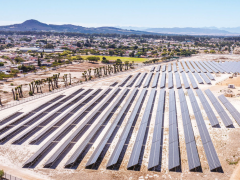
One of the early milestones in South Africa’s wheeling market came in 2020 with the financial close of SOLA’s 12 MWp solar project supplying Amazon. Although modest in size, the project demonstrated that privately developed renewable generation could be financed and operated under a wheeling arrangement using long-term power purchase agreements (PPAs).
The market expanded significantly following the decision by the National Energy Regulator of South Africa (NERSA) in 2022 to remove licensing requirements for larger generation facilities. Subsequent projects demonstrated that wheeling could move beyond pilot-scale developments into utility-scale private power supply.
According to NERSA registration data, more than 19 GW of new generation facilities have been registered with much of this capacity intended to supply private buyers through wheeling arrangements.
Data compiled by the Power Futures Lab at the University of Cape Town indicates that six major projects, totalling 1 788 MW, reached financial close during the first months of 2026. Should the current development pipeline proceed as expected, more than 5 700 MW of projects could be financed this year.
New participants in a changing market
The growth of wheeling has been accompanied by the emergence of new market participants.
Independent power producers continue to develop, own and operate generation assets. Electricity traders aggregate demand and supply, purchasing electricity from generators and selling it to end users. GenTraders combine both functions by owning generation assets while also holding trading licences.
Together, these participants are helping to create a more competitive and accessible private electricity market.
The sector’s growth has also been supported by increasing participation by commercial banks and development finance institutions, which are funding utility-scale renewable energy and battery storage projects. Recent wheeling projects financed by South African lenders demonstrate growing confidence in the market and its long-term prospects.
What wheeling means for business
For many companies, wheeling offers greater certainty about future electricity costs.
This is not about avoiding the grid. Wheeled electricity still uses Eskom’s transmission and distribution infrastructure and remains subject to associated network charges. However, long-term PPAs can provide greater predictability than relying exclusively on regulated tariff increases.
Wheeling is also becoming increasingly relevant from a sustainability perspective. As export markets introduce stricter carbon-related requirements, access to renewable energy is becoming an important competitive consideration for many South African businesses.
By separating the location of generation from the point of consumption, wheeling allows companies in urban or space-constrained environments to access renewable energy generated in areas with stronger solar and wind resources.
Supporting market liberalisation
Wheeling is also laying important foundations for the South African Wholesale Electricity Market.
The electricity sector is evolving from a system dominated by a single supplier towards a more competitive market in which multiple generators, traders and customers interact through market-based structures.
Virtual wheeling arrangements are extending these opportunities further, allowing customers connected to municipal networks to participate in renewable energy procurement through settlement mechanisms linked to Eskom billing arrangements.
Behind-the-meter generation remains an important part of the energy mix. On-site solar and storage solutions continue to provide value for many customers, particularly where energy security and operational resilience are priorities. However, wheeling offers the scale required to support broader decarbonisation and large-scale private investment in generation capacity.
Wheeling has helped unlock private capital, expand renewable energy deployment and provide businesses with new procurement options. As South Africa’s electricity market continues to evolve, it is likely to remain a key mechanism enabling greater competition, investment and customer choice within the power sector.