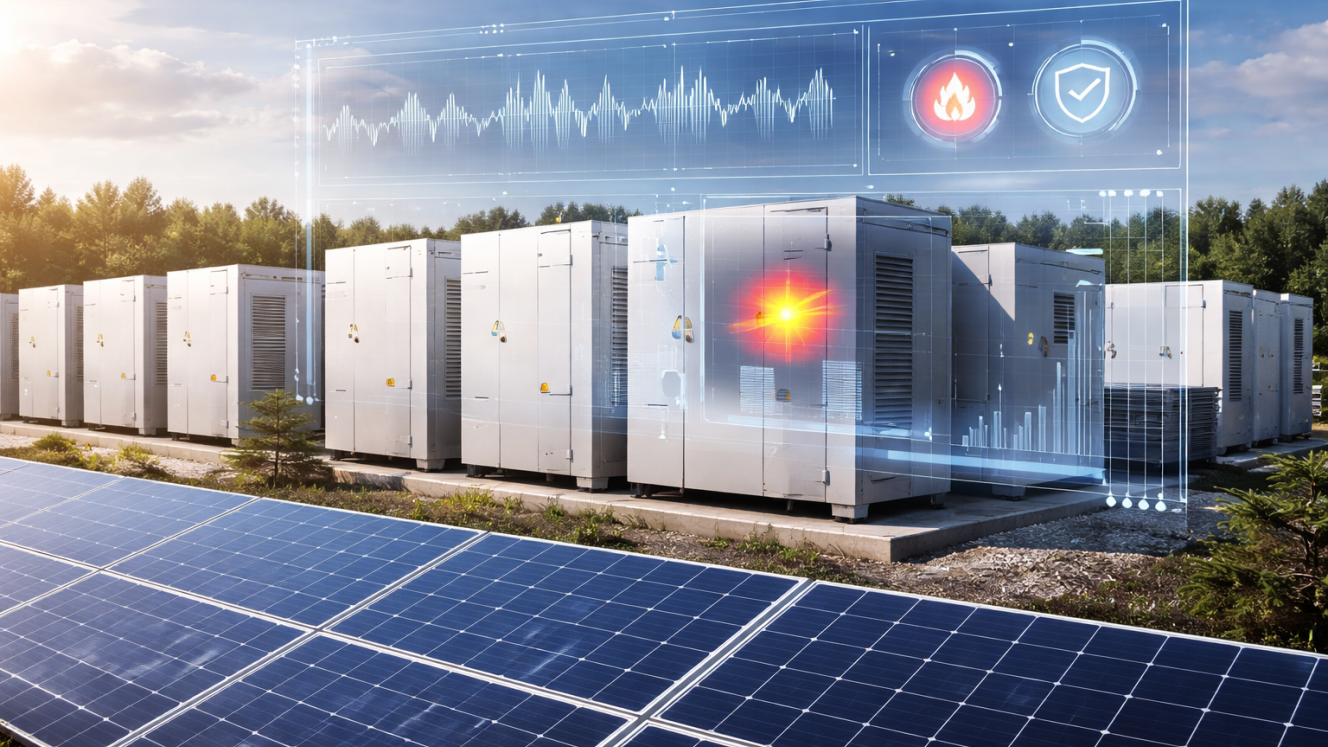
Industry stakeholders have cautioned that predictive monitoring, while increasingly adopted, is unlikely to prevent fire incidents in solar photovoltaic (PV) and battery energy storage systems (BESS) without broader improvements in system design, installation and compliance.
This emerged during an EE Business Intelligence webinar on April 13, which examined safety risks in residential and commercial PV and BESS installations.
Chief Technical Officer and Co-Founder of GoSolr, Patrick Narbel, said early fault detection can play a role in preventing incidents, particularly in battery systems.
“When battery systems are actively monitored, particularly for conditions such as thermal runaway, you can stop it before it happens,” Narbel said.
Chief Solutions Architect at Huawei Digital Power, Shane Marcelo Prins, pointed to advances in inverter and system-level protection, including arc-fault detection and rapid shutdown capabilities. He said these systems are able to detect abnormal electrical behaviour and isolate faults within milliseconds, reducing the likelihood of ignition at source.
However, speakers consistently emphasised that monitoring technologies are only one component of a broader safety framework.
“Safety is a system outcome, underscoring that design, component quality and compliance all play interdependent roles,” said Andre van der Elst, Convenor of the SABS 10142-1 Working Group.
This view was echoed by Regional Director: Highveld for the Electrical Contractors Association, Anthony Schewitz, who said installation quality remains a persistent risk factor with many failures linked to human error rather than technology limitations.
Additional comments highlighted system design and component selection as key risk factors, particularly as installations increase in scale and complexity.
“Correct sizing, placement and integration of components are critical to minimising risk,” said Hein Herholdt, CEO of Herholdt’s Group.
Leon Roos, Compliance and Safety Consultant and Member of the SABS 10142-1 Working Group, added that monitoring must be supported by ongoing inspection and maintenance, warning that faults may remain undetected without structured oversight.
“Standards and enforcement mechanisms will need to evolve in line with technological advancements,” Roos said.