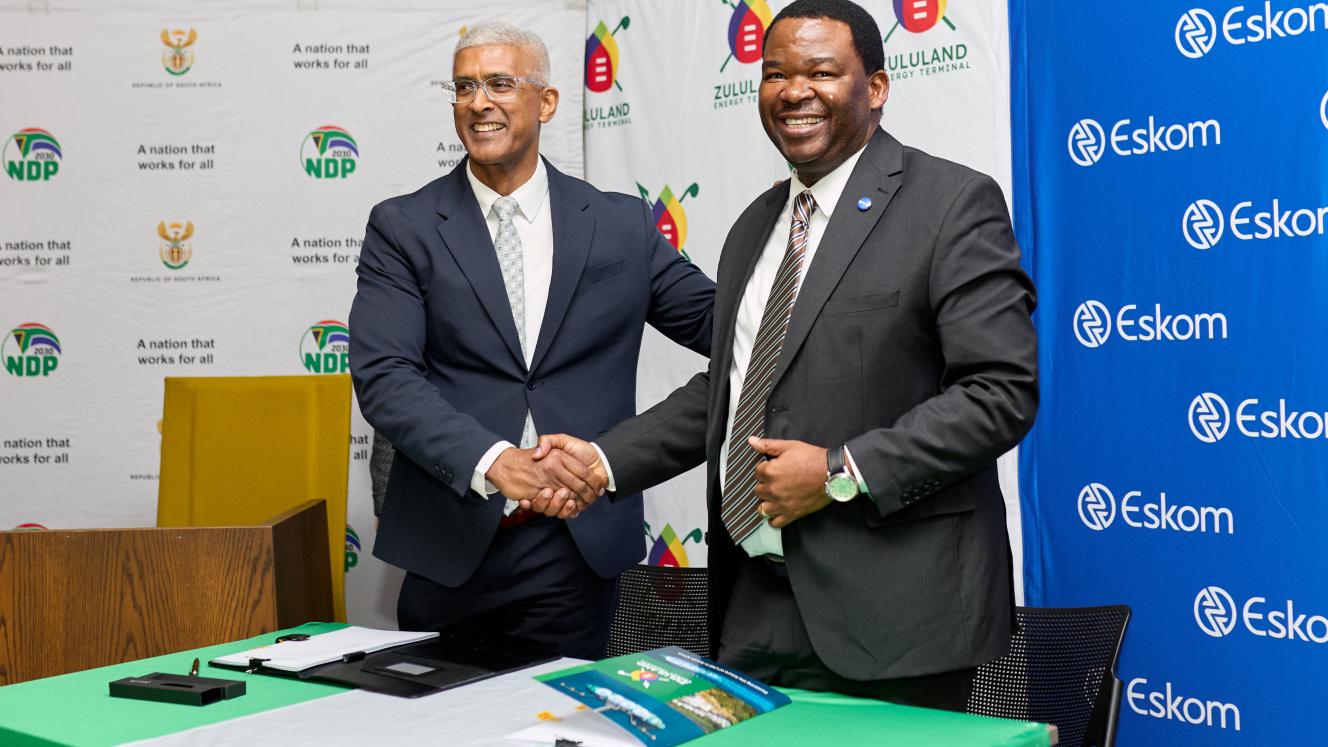
Eskom has signed a heads of agreement with Zululand Energy Terminal (ZET), giving it foundation customer status at the proposed Richards Bay liquefied natural gas (LNG) import terminal that will support its planned 3 000 MW gas-to-power project.
The agreement also establishes a framework for a long-term partnership as Eskom and ZET progress regulatory approvals, long-term commercial contracting, project structuring and infrastructure development. ZET is a joint venture between Vopak Terminal Durban, Reatile Group and Transnet Pipelines.
The agreement moves the commercial side of the delayed Richards Bay LNG rollout forward after the Supreme Court of Appeal set aside Eskom’s environmental authorisation for the gas-to-power project in September 2025, pushing the target to 2028.
The KwaZulu-Natal Logistics Hub masterplan sees Richards Bay “serving as the country’s leading industrial port and premier dry bulk and LNG port”.
According to the Transnet National Ports Authority (TNPA), the LNG project includes a floating storage unit and an onshore regasification facility capable of handling two million tonnes of LNG a year, expandable to five million tonnes.
Transnet is also in the process of upgrading the existing 580 km Lilly pipeline, which runs from Secunda through Empangeni to Durban, to handle LNG.
The 3 000 MW gas-to-power project will be constructed and operated in the Richards Bay Industrial Development Zone in KwaZulu-Natal, Eskom and ZET said in a joint statement.
Regasified LNG is expected to be the primary fuel source for the plant, which has a planned 25-year life cycle and will operate mainly as a mid-merit facility, the statement said.
It has been designated as a Strategic Integrated Project under the Infrastructure Development Act and is included in the Integrated Resource Plan (IRP) 2025.
Development will follow a private-sector participation model using strategic partners, project finance and long-term power offtake arrangements.
The IRP 2025 calls for 6 000 MW of gas by 2030 split between 3 000 MW under the gas independent power producer programme and 3 000 MW to be delivered by Eskom.
“Gas is being used as a bridge fuel to support the transition to a low-carbon energy system. These gas plants are designed to complement intermittent renewable sources like solar and wind, ensuring reliable 24/7 power, while clean energy technologies are being developed and introduced onto the grid,” said Eskom Group Chief Executive Dan Marokane.
“The availability of dispatchable power is at the very heart of the energy transition and industry cannot operate without it as it forms the backbone for renewable energy integration into the grid.”
Securing foundation customer status at ZET would allow for a long-term contracting approach to minimise volatility and support system reliability while aligning with IRP 2025 objectives, Marokane said.
“This agreement strengthens the commercial foundation of the terminal and we look forward to building a long-term partnership as we progress towards a terminal use agreement, financial close and the delivery of South Africa’s first LNG import terminal.”
Other Richards Bay infrastructure projects are also underway. Back-of-port projects include the reconfiguration and upgrading of the TNPA Bayvue rail yard in Richards Bay, a 20 MW solar plant and the upgrading of Newark Road leading into the port.