
The renewable energy sector stepped up when legacy infrastructure was struggling to keep up. Now this sector is changing the nature of the industry in South Africa on multiple levels. From employment to innovation to global best practice, South Africa’s renewable energy economy is transforming how the industry operates. Yet, when it comes to employment and skills development, the sector continues to grapple with some serious gaps, says Alicia Dean, Head of People and Group Services at SOLA Group.
The first is permanence. The industry has not yet fundamentally transformed net job creation with industry estimates suggesting that only about 6 000 permanent jobs have been created to date. The rest are temporary. Many people are employed during the construction phases of projects but their skills do not always translate into long-term roles once projects move into operation.
Another challenge is how South Africa’s exceptionally high unemployment rate affects the adoption of intelligent technologies. Automation and robotics that may make sense in other regions cannot always be applied in the same way locally without displacing people who rely on jobs for their livelihoods. There is a constant need to strike a balance between evolving and advancing technologically while ensuring people are not left behind.
This dynamic has contributed to a uniquely South African version of the clean energy transition. The industry continues to modernise but often does so with stronger emphasis on employment and economic participation. In practice, this has widened the definition of what the renewable energy workforce looks like, placing greater weight on roles and attributes that were not as prominent a decade ago.
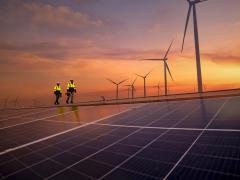
The move towards large-scale renewable energy deployments has increased demand for specialised skills but many of these are not entirely new roles. Instead, they are extensions of existing professions reshaped by the complexity of modern projects. As more solar and battery plants move from development into operation, there is growing demand for asset managers, performance analysts, operations and maintenance specialists and grid engineers – roles that ensure plants operate optimally over their full lifecycles.
Cybersecurity has also emerged as an increasingly important consideration. Modern energy plants rely heavily on digital control and networking technologies that enable remote monitoring and data collection. Protecting these systems is critical as downtime or disruption can have serious operational and financial consequences. At the same time, the volume of data generated by these systems has increased demand for skills in data analytics and management, supporting more informed decision-making around plant performance, operational risk and preventative maintenance.
Looking to the future, the introduction of the South African Wholesale Electricity Market is expected to further influence skills demand. Energy trading, day-ahead forecasting and financial modelling are established career paths in more mature electricity markets but remain relatively new in South Africa. As the market opens, these skills are likely to become increasingly important, creating opportunities for skills transfer between the financial services and energy sectors.
The renewable energy sector is also attracting experienced professionals from mining, oil and other heavy industries who are seeking work that contributes to long-term energy security and climate resilience. Many are drawn by the pace of change and the problem-solving ethos that characterises the sector alongside a desire to apply their expertise in a rapidly evolving environment.
Building a sustainable workforce, however, requires long-term investment in skills development that reaches beyond project-based interventions. Much of the current skills development effort takes place through localised initiatives aligned with construction sites or partnerships with universities and technical and vocational education and training colleges. Internship and vacation work programmes help create exposure but do not yet meet the scale of national demand for specialised renewable energy skills.
While construction phases continue to offer the greatest volume of short-term employment, operations and maintenance roles provide fewer but more enduring opportunities. These roles are critical to system reliability and asset performance but they require deliberate planning and targeted training pathways to ensure sufficient depth of expertise.
The clean energy transition is creating new job categories and redefining existing jobs. It is expanding opportunities while demanding new skills, new mindsets and new forms of collaboration. To realise its full potential, the sector will need to prioritise skills development alongside infrastructure investment, ensuring South Africa’s workforce is equipped to support a more complex, digitally enabled and increasingly market-driven electricity system.