A 7,4 MWp rooftop solar PV system in Germany has been successfully retrofitted, demonstrating how ageing commercial and industrial PV assets can be upgraded to improve energy yield without expanding installed capacity. According to Tobias Söhnchen, Managing Partner at PV³, the project shows how output gains can be achieved through modernisation rather than capacity expansion. PV³ was responsible for project management, planning, quality control and commissioning.
The system, originally installed in 2010 on the roof of a former logistics warehouse in Philippsburg, underwent a full module replacement and reconfiguration while retaining much of the original balance-of-system infrastructure. Söhnchen says the retrofit increased expected annual energy output by up to 35% while maintaining the original rated capacity.
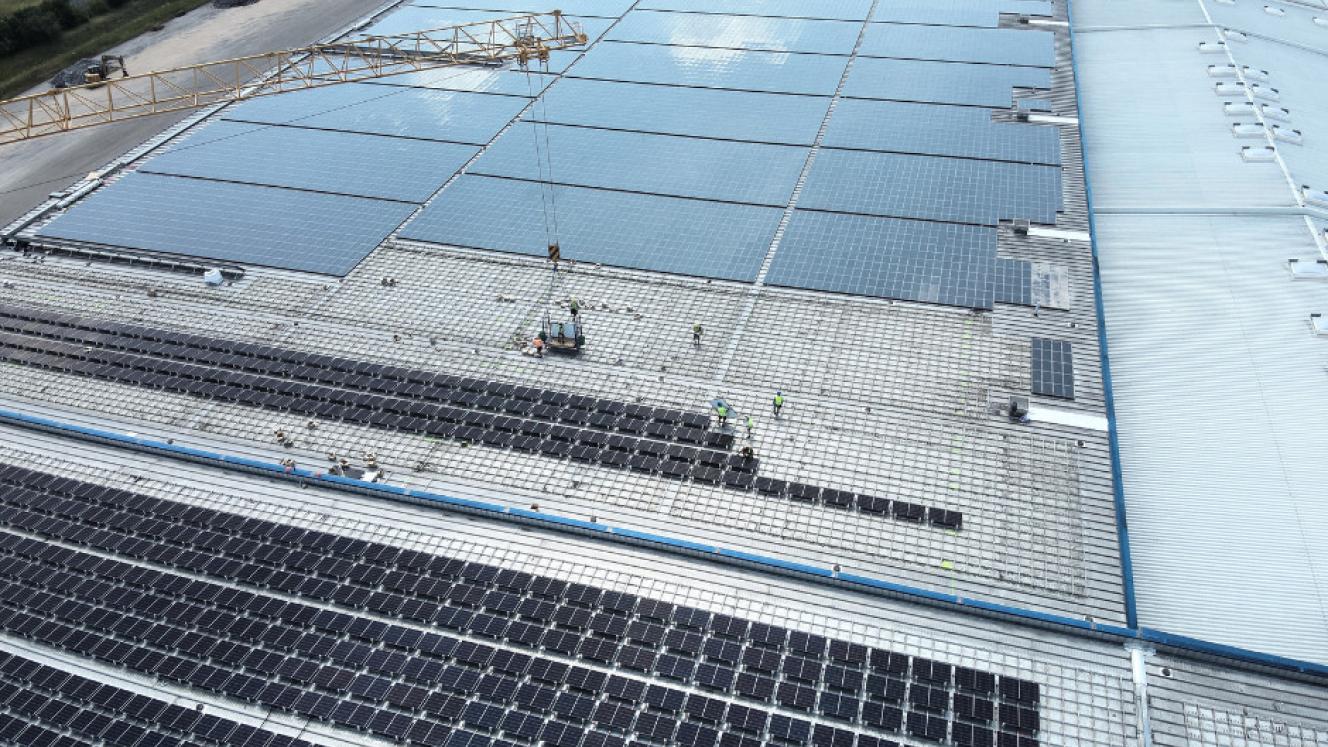
The modernisation involved replacing approximately 96 000 roof parallel thin-film modules with about 16 000 higher-efficiency crystalline modules. The new modules were installed at a 10-degree south-facing tilt to improve irradiation capture. Existing mounting profiles, generator junction boxes and AC-side infrastructure were reused while module supports, struts and clamps were replaced following updated structural calculations, explains Manuel Schwarzmaier, Project Manager at Schletter Group. Schletter supplied the mounting solution and carried out the structural redesign required for the reconfigured system.
Structural load constraints were a key consideration, given the scale of the 113 000 m² roof area and ongoing warehouse operations below. Load recalculations and aerodynamic optimisation enabled the upgraded system to reduce roof loading compared with the original configuration despite the higher performance modules.
To limit production losses during construction, the retrofit was executed in phases with inverters taken offline sequentially so that most of the plant remained operational throughout the process. Module removal and installation were carried out in a single step using large cranes, avoiding intermediate storage on the roof and minimising point loads.
Post-installation testing included drone-based infrared inspections, electroluminescence testing and I-V curve measurements under illuminated and dark conditions. The system was commissioned by an independent, publicly appointed expert in October 2025.
“Retrofitting is not a plug-and-play solution but a complex process that requires in-depth technical and economic analysis,” says Söhnchen. “Success hinges on customised planning and competent execution – which, in this case, worked extremely well thanks to the close collaboration of all project partners.”