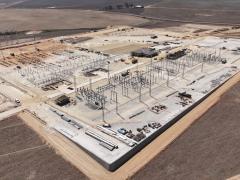
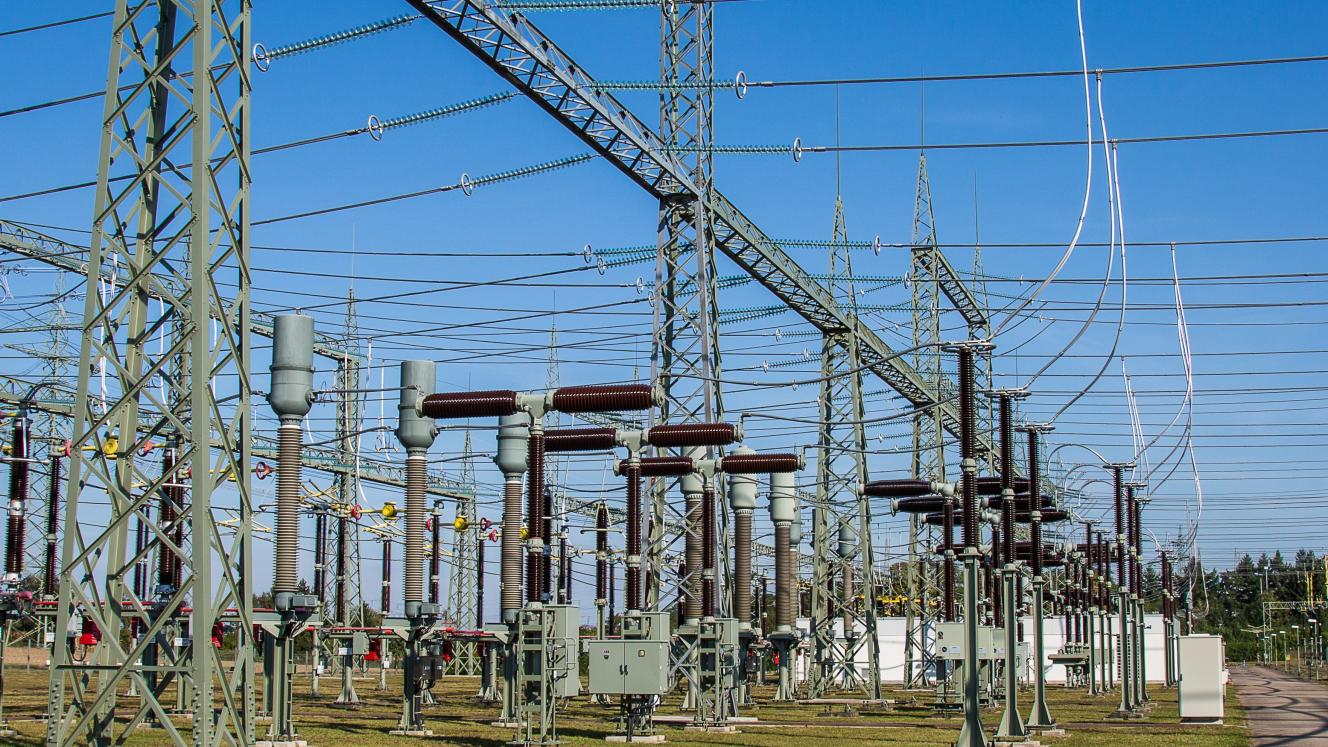
A technical study presented by the National Transmission Company South Africa (NTCSA) at the CIGRE Southern Africa Regional Conference in Pretoria in October 2025 has highlighted the structural implications of dynamic forces generated during circuit breaker operations. The work focused on the refurbishment of the Fordsburg substation in Johannesburg where equipment is supported on suspended concrete slabs rather than ground-founded structures.
The Fordsburg substation, a 275/88 kV indoor air-insulated installation, is undergoing an upgrade in which legacy horizontal puffer-type circuit breakers are being replaced with modern vertical disconnecting units, says Azhar Maye of the NTCSA who co-authored the study. While the new breakers improve electrical performance and reliability, their rapid mechanical operating time of approximately 30 milliseconds introduces significant inertial forces into the supporting structure.
Unlike most substations, where breakers are installed on ground-supported foundations, the Fordsburg breakers are mounted on a suspended reinforced concrete slab supported by beams and columns approximately 13 m high. This configuration prompted an investigation into the structural response of the slab to operational CB loads.
The study used finite element modelling and transient dynamic analysis to assess the slab and supporting beams. Because detailed original structural data was unavailable, reasonable assumptions were made regarding slab and beam dimensions and reinforcement. The analysis first established the deformed state of the structure under permanent loads using linear static analysis, which was then used as the starting condition for a linear transient dynamic analysis.
The applied load model was based on manufacturer test data in the form of a time-history record of bolt forces during circuit breaker operation. Using a small time step to capture the short-duration load and potential high-frequency structural response, the dynamic analysis indicated that certain slab regions could experience high vibration amplitudes and bending moments under the original load case.
To refine the assessment, a simplified beam sub-model was developed and used to perform a series of sensitivity studies. In these analyses, the amplitude and period of the applied load were varied systematically. Results showed that reducing the load amplitude and increasing the load period produced responses closer to static behaviour with reduced dynamic amplification.
A key issue identified in the study is lack of standardised, usable load models for circuit breaker operational forces, Maye says. Manufacturers typically provide peak force values but not time-dependent load profiles suitable for structural dynamic analysis. According to Maye, measured data can also be influenced by the flexibility of test setups, potentially leading to non-representative frequency content.
He recommends that future testing includes measurements = at the equipment interface and on the broader support structure to capture local and global dynamic behaviour. In situations where measured time-history data is unavailable, the study proposes the use of a half-sine pulse as a practical and representative load model for circuit breaker operations in transient dynamic analysis.
The work highlights the need to explicitly consider dynamic loading where high-voltage equipment is installed on suspended or otherwise flexible structural systems, and to improve coordination between equipment suppliers and structural engineers in defining realistic operational load inputs.