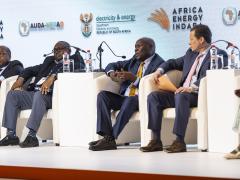
Industrial organic waste streams are facing increasing regulatory and cost pressures driving renewed interest in technologies that can convert difficult waste into multiple energy outputs, according to research presented at the third annual South African National Energy Development Institute conference.
Presenting his findings, University of KwaZulu-Natal chemical engineer and researcher Gaogane Gaogane said slaughterhouse waste represents one of the more challenging waste streams due to its high moisture content and toxicity, making it increasingly difficult to dispose of through conventional landfill routes.
“Slaughterhouse waste streams are high in moisture and toxic,” Gaogane said, noting that tightening waste management practices are limiting traditional disposal options and increasing costs.
This challenge is reflected more broadly in the sector. Research conducted in the Western Cape has identified abattoir waste as one of the most problematic waste types to manage due to its hazardous environmental impact and associated compliance requirements.
Against this backdrop, Gaogane’s work explores how such waste streams can be treated through an integrated system combining fermentation, anaerobic digestion and downstream processes, such as pyrolysis, enabling the recovery of multiple energy products.
The proposed model allows for hydrogen to be produced during early-stage biological processes with the remaining material further processed to generate methane and other energy carriers.
“You are able to recover hydrogen and then pass it down to produce methane,” he explained.
This multi-stage approach reflects a broader shift towards extracting maximum value from organic waste streams, positioning them as potential decentralised energy resources rather than purely disposal challenges.
However, the research also highlights key technical constraints that may limit large-scale application. The protein-rich composition of slaughterhouse waste introduces high levels of ammonia during processing, which can inhibit microbial activity and suppress hydrogen production.
“Ammonia is very toxic to micro-organisms,” Gaogane said.
To address this, the study investigated mitigation strategies, including the use of biochar, which was found to improve system performance by reducing ammonia concentrations and supporting microbial activity.
Findings also indicate that feedstock composition plays a critical role in determining energy yields, with carbohydrate-rich substrates producing higher hydrogen outputs than protein-heavy waste streams such as those derived from animal processing.
Despite these limitations, the research points to a circular model in which waste streams can be continuously repurposed, reducing disposal burdens while generating useful energy products.
With landfill constraints tightening and environmental compliance requirements increasing, such integrated waste-to-energy systems are being positioned as a potential pathway for industrial operators to manage complex waste streams while recovering value from them.